
Online Chemicals Solution
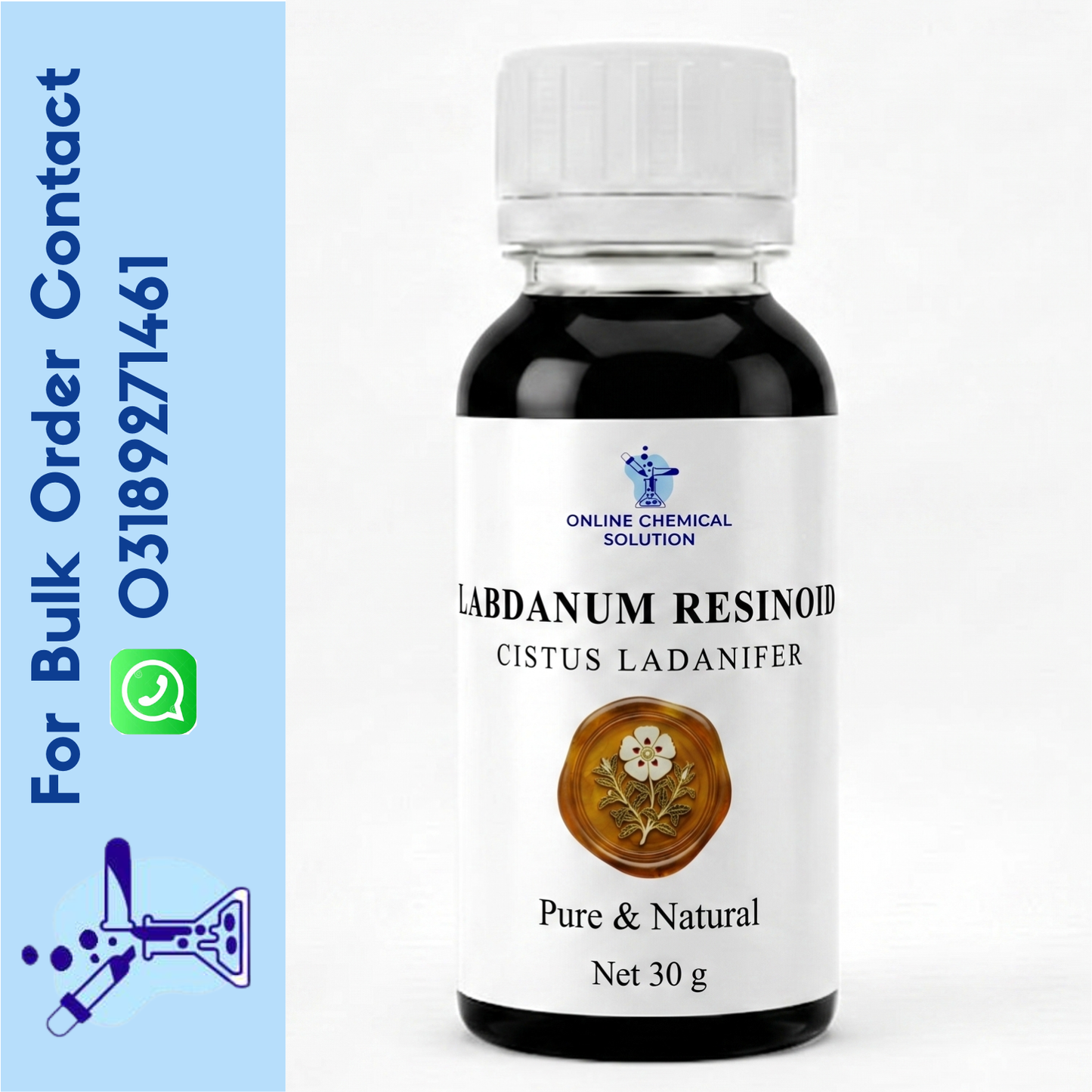
Labdanum Resinoid
Labdanum Resinoid
Couldn't load pickup availability
Important Note: We sell by Weight (Grams/KG), not Volume (ML). Because essential oils are lighter than water, our 100g bottle actually gives you ~15-18% more oil than a standard 100ml bottle. More purity, more value in every drop
Labdanum is one of perfumery's oldest and most prized ingredients, and for good reason. It is complex, deeply resinous, and genuinely difficult to replicate synthetically in a way that captures its full character. For formulators working on premium fragrances, natural perfumes, or high-end skincare, Labdanum Essential Oil is the kind of raw material that elevates a finished product in ways that cheaper alternatives simply cannot. If you are serious about your formulations, this is an ingredient worth understanding properly.
What is Labdanum Essential Oil?
Labdanum Essential Oil is derived from the resinous exudate of Cistus ladanifer, a flowering shrub native to the Mediterranean region, particularly Spain, Portugal, and parts of North Africa. The plant naturally secretes a dark, sticky resin called labdanum from its leaves and stems, which has been harvested and used in perfumery and traditional medicine for thousands of years. Historical references to labdanum stretch back to ancient Egypt, where it was used in incense, kyphi formulations, and early cosmetic preparations.
The oil itself is typically obtained through solvent extraction or steam distillation of the crude resin or plant material. It is closely associated with ambergris in perfumery, as it shares a warm, animalic, amber-like aromatic character that makes it one of the most effective natural ambergris substitutes available to formulators.
It is worth being clear about terminology here. Labdanum is sometimes confused with Cistus Essential Oil, which is steam distilled directly from the fresh flowering tops of the same plant. The two are related but distinct in aroma and application. Labdanum is richer, darker, and more resinous in character, while Cistus oil is sharper and more camphoraceous on the top notes.
Scent Profile and Key Properties
Labdanum has one of the most complex and layered scent profiles in natural perfumery. The opening is warm, resinous, and slightly sweet, with a subtle animalic quality that gives it genuine depth. As it dries down, it develops into a rich, ambery, almost leathery base that lingers on skin and fabric for an exceptionally long time.
Practical formulator notes:
Labdanum is a heavy, viscous oil, particularly in cooler temperatures. Gentle warming before use is strongly recommended to make measuring and blending practical, especially in small batch production where precision matters.
As a base note, it is one of the most effective natural fixatives available. It does not just add its own character to a blend, it actively extends the longevity of the top and heart notes built above it. This makes it especially valuable in perfume oils, solid perfumes, and leave-on skincare.
The colour is a deep amber to dark brown, and it will visibly affect the colour of any light or pale formulation it enters. This is an expected property of the ingredient and needs to be factored into product development for anything where appearance matters.
The scent is potent and rich. Overuse will push a blend into heavy, almost suffocating territory. It is best used with restraint as an anchor and fixative, with the percentage kept conservative relative to the overall formula.
Shelf life is excellent. Like most resinous oils, Labdanum is naturally stable and resists oxidation well. Stored correctly in a cool, dark environment, it will remain in good condition for several years.
Key Benefits and Properties
- Rich, complex resinous and amber-like aroma that functions as a premium base note and fixative in natural perfumery
- One of the most recognised natural substitutes for ambergris in fragrance formulation
- Exceptional fixative properties that extend the longevity of top and heart notes in a blend
- Naturally long shelf life due to its resinous, stable chemical composition
- Valued in premium skincare for its skin-relevant properties associated with resinous botanical extracts
- Adds genuine depth and complexity to oriental, woody, chypre, and amber fragrance families
- Ancient botanical origin with a well-documented history in perfumery and cosmetic use
Common Applications
- Fine fragrance and natural perfume oil blending as a base note and fixative
- Oriental, amber, chypre, and woody fragrance compositions
- Luxury body oils, balms, and leave-on skincare formulations
- Solid perfume and wax-based fragrance products
- Premium soap formulations where a deep, resinous base note is desired
- Aromatherapy blends targeting grounding and calming effects
- Incense and home fragrance formulations
Technical Specifications
| Property | Detail |
|---|---|
| Botanical Name | Cistus ladanifer |
| Plant Part | Resinous exudate from leaves and stems |
| Extraction Method | Steam Distillation / Solvent Extraction |
| Colour | Deep amber to dark brown |
| Consistency | Thick, viscous, semi-resinous |
| Aroma | Warm, resinous, amber-like, with animalic depth and a leathery dry-down |
| Solubility | Oil soluble, not water soluble |
| Available Sizes | 30g, 100g, 500g, 1kg |
| Storage | Store in a cool, dark place away from direct sunlight and heat. Warm gently before use if viscosity is high |
Why Choose CosmetiHub?
CosmetiHub supplies cosmetic-grade Labdanum Essential Oil sourced for the serious formulator. Whether you are building a natural perfume, a premium body oil, or a high-end skincare product, you need a supplier who understands what the ingredient actually is and what it does. We keep things simple, pure ingredients, accurate information, and pricing that makes sense for small batch production.
If you are looking to buy Labdanum Essential Oil in Pakistan, CosmetiHub provides a reliable source of pure cosmetic-grade raw materials for formulators who take their craft seriously.
Suitable for professional cosmetic formulation, DIY skincare, aromatherapy, soap making, and home fragrance.
Share